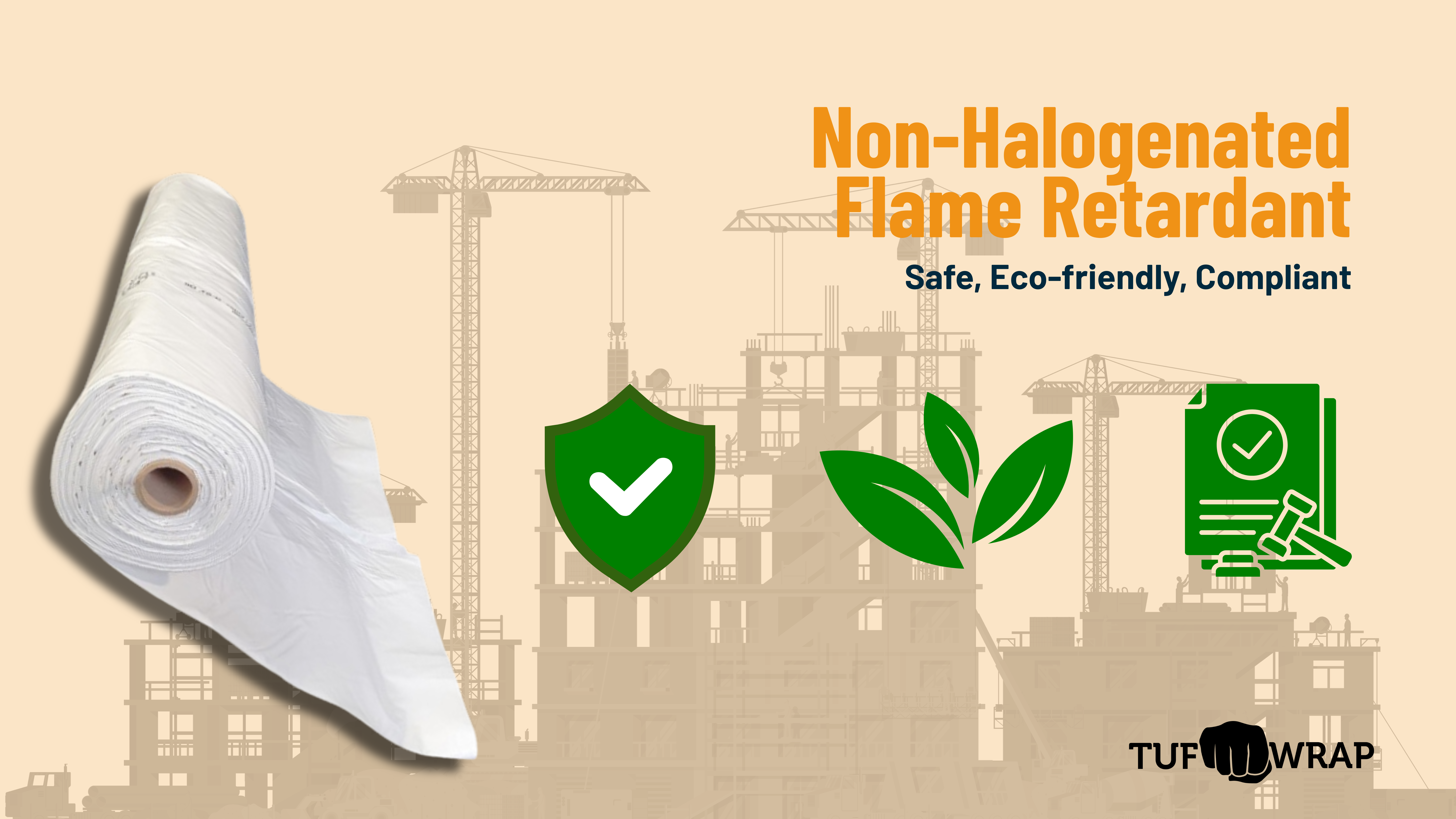
Across Australia and internationally, a growing body of research and regulation is reshaping the conversation around flame retardant safety. Materials that once passed without scrutiny are now under the microscope for their environmental, health, and lifecycle impacts. And at the centre of that shift is the comparison between halogenated and non-halogenated flame retardants.
At Tufwrap, we’ve always made our position clear: non-halogenated is the safer, smarter choice. Not just because of what’s in it, but because of what it means for the long-term success and integrity of your project.
Non-halogenated flame retardants are becoming the standard for future-facing infrastructure. Choosing the right material today can safeguard your work for years to come.
What Are Non-Halogenated Flame Retardants?
Non-halogenated flame retardants are materials that reduce flammability without the use of Halogens, a family of chemicals that includes chlorine, bromine, fluorine, and iodine.
Instead, non-halogenated retardants rely on alternative chemistries.These alternatives are designed to suppress flames effectively while significantly reducing the production of toxic gases and harmful residues during combustion.
Crucially, they also break down more safely in the environment, meaning less long-term ecological impact, a key factor in public projects and green-rated developments.
Why the Industry Is Moving Away from Halogenated Compounds
Halogenated flame retardants became popular decades ago due to their low cost and initial effectiveness. But over time, their unintended consequences have become impossible to ignore.
Research shows that many halogenated compounds:
- Release highly toxic fumes (e.g., dioxins, hydrogen chloride) when burned
- Persist in the environment and bioaccumulate in wildlife and humans
- Have been linked to endocrine disruption, cancer, and developmental issues
These concerns are not hypothetical, they’ve been documented globally and are shaping regulatory responses in countries including the EU, Canada, and now Australia.
A Regulatory Turning Point in Australia
In 2021, the Australian Government signalled its intention to align more closely with international standards on hazardous chemicals. A key milestone in this transition is the ban on certain brominated flame retardants, effective 1 July 2025.
Source: DCCEEW Chemical Management News
This will have real implications for:
- Government contractors: All publicly funded projects will be expected to move away from halogenated materials
- Procurement teams: Existing suppliers using banned substances will require re- evaluation.
- Compliance officers: Documented materials must align with evolving legislation or face audit risk.
This shift makes one thing clear: projects that continue using halogenated flame retardants after July 2025 could be exposed—legally, financially, and reputationally.
The Case for Non-Halogenated: 5 Key Advantages
1. Cleaner, Safer Fire Performance
In the event of a fire, halogenated materials can emit dark, corrosive, and toxic smoke. Non-halogenated alternatives release significantly less toxic gas, improving survivability and aiding emergency response.
For indoor environments, confined worksites, or high-occupancy structures, this can be a critical difference.
2. Reduced Environmental Impact
Unlike halogenated compounds, which resist natural degradation, non-halogenated flame retardants are non-persistent and non-bioaccumulative. This reduces long-term contamination risks and supports circular economy goals. They are also more compatible with recycling and waste recovery programs, a growing requirement in green infrastructure certification schemes.
3. Regulatory Peace of Mind
With international and domestic regulators tightening their stance on chemical safety, non- halogenated materials offer a future-proof choice. Contractors using these materials today can demonstrate proactive compliance, not just reactive correction.
4. Improved Indoor Air Quality
During normal use (not just in fires), halogenated flame retardants have been found to leach into indoor air and dust, potentially exposing occupants. Non-halogenated solutions reduce that risk, supporting healthier environments in schools, hospitals, and offices.
5. Stronger Project Reputation
Public clients, ESG-conscious developers, and Tier 1 builders are increasingly selective about the materials used in their supply chain. Choosing non-halogenated flame retardants signals leadership in safety and sustainability.
Why Tufwrap Doesn’t Compromise
Tufwrap has never used halogenated flame retardants in our temporary protection systems. While others looked to cut costs through offshore imports or legacy formulations, we invested in safe, high-quality, non-halogenated alternatives—built specifically for Australian conditions.
We’re proud to support some of the country’s most complex and safety-sensitive builds, and we’ve earned that trust by refusing to cut corners on material safety.
Questions You Should Be Asking Suppliers Today
If you’re not 100% sure what’s in your flame retardant, here are some questions to bring to the table:
- Can you confirm this product is free from halogenated compounds?
- Is it compliant with upcoming Australian regulations (from July 2025)?
- Do you have third-party documentation on combustion byproducts?
- What is the end-of-life plan for this material? Can it be safely disposed of or recycled?
If the answers aren’t clear, or if the supplier avoids them, that’s a sign to reassess.
A Smarter, Safer Choice for Australia’s Next Chapter
Whether you’re building major infrastructure, managing government projects, or just committed to safer construction practices, your materials matter. Flame retardants might seem small in the context of a massive project, but their impact spans safety, compliance, sustainability, and reputation.
As Australia takes the next step toward smarter chemical management, non-halogenated flame retardants are no longer a niche option, they’re the standard of responsible practice.
Tufwrap is proud to lead the way.
We offer non-halogenated flame-retardant protection for construction and industry. Discover our flame-retardant solution or contact us today to talk to a member of our team.