Reinforced containment sheeting is one of the most critical, yet often overlooked, elements of any major project. It serves as your primary defence for safety, temporary weather protection, and environmental compliance, ensuring project continuity regardless of external factors. For contractors managing tight deadlines and strict regulations, the choice of containment material is not just a protective measure—it’s a direct determinant of efficiency and financial risk.
Unfortunately, many sites still rely on legacy materials like PVC or older LDPE composites. These materials are notorious for their excessive weight, difficulty in handling, environmental drawbacks, and inevitable breakdown over short lifespans, leading to costly re-work and disposal issues.
This guide moves beyond those outdated practices. We will define the modern selection criteria you should demand from your materials and outline best practices for achieving long-term, high-performance containment on every job.
What are the Key Selection Criteria for High-Performance Sheeting?
Is Your Sheeting Truly Strong and Durable Enough for the Job?
The core function of containment sheeting is reliable strength. In the past, strength was synonymous with mass. Today, however, high-performance engineering has changed that equation.
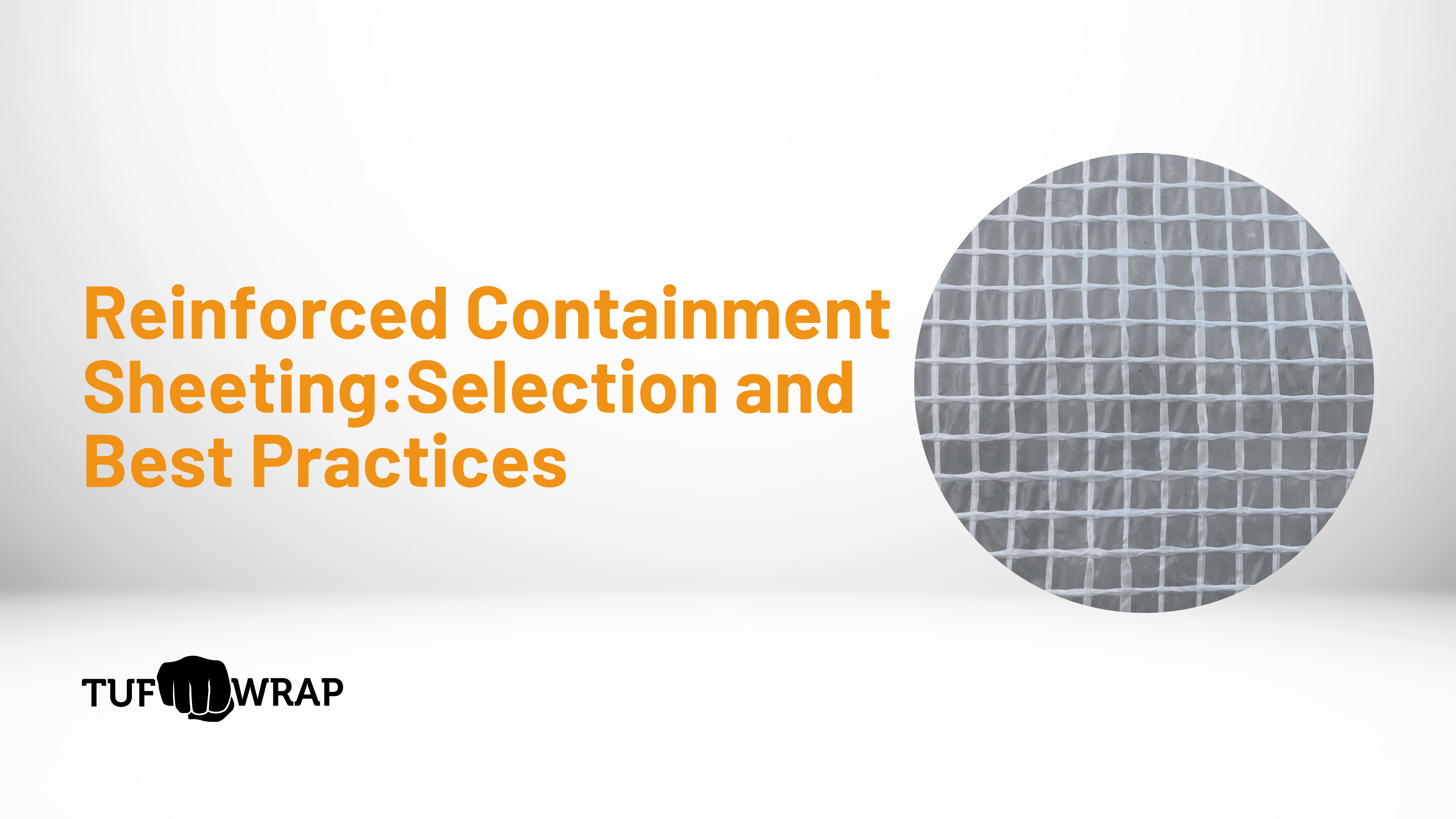
You must look past basic specifications and inspect the Performance-to-Mass Ratio. A superior reinforced scrim structure, like those found in advanced composites, allows for significantly reduced material weight without sacrificing integrity. For example, next-generation sheeting can achieve equivalent performance to a 440GSM LDPE scrim with only a fraction of the weight, thanks to a reinforced knitted scrim and superior coating. This dramatic increase in efficiency and strength-to-weight ratio is essential for managing wind, abrasion, and heavy-duty applications. Look for sheeting with robust weave options, such as 3×3 and 4.5×4.4 Weave, to guarantee superior rip and tear strength.
Furthermore, true durability requires longevity. Your material must be UV stabilised for outdoor use and guarantee zero weight loss or plasticiser leaching over its service life, preventing the material from degrading, hardening, and failing prematurely.
Are You Wasting Time and Money on Weight and Logistics?
Weight directly correlates to cost on any large-scale project. Heavy, bulky containment sheeting adds expense and time at every logistical step, from the warehouse to the final installation point.
By choosing sheeting that is up to half the weight of traditional options, you immediately realise savings in transport, labour, and equipment rental. Lighter materials translate into faster deployment, easier manipulation by installation crews, and improved safety.
Look for a material with an ultra-lightweight format and a flexible, soft surface. This enhanced manageability is particularly critical for large-scale applications like marine wrapping, environmental encapsulation, or quick emergency tarping, where ease of handling directly dictates the speed and quality of installation.
Can Your Containment Meet Modern Safety and Sustainability Standards?
The industry is rapidly pivoting toward greener, safer practices, and your sheeting choice must keep pace.
- Safety: Prioritise materials that are toxic-free and environmentally responsible. Traditional PVC and older plastics can contain plasticisers that leach out over time. Modern alternatives must be safe for installers and the environment. Additionally, ensuring the material is flame retardant (non-brominated) is non-negotiable for site compliance and worker safety.
- Sustainability: The biggest differentiator in next-generation sheeting is full recyclability. Conventional products often combine dissimilar materials (e.g., LDPE coatings on a polyester scrim), creating a complex, multi-layered product that is difficult or impossible to recycle. The new standard requires a single-polymer solution—such as sheeting composed of a Polypropylene scrim and Polypropylene coating. This design guarantees a unified, fully recyclable stream, enabling simplified end-of-life planning and meeting modern sustainability mandates without sacrificing performance.
Best Practices for High-Performance Containment
The best material in the world will fail if poorly installed. Implementing these best practices ensures you maximise the high-performance features of modern sheeting.
A. Site Preparation and Risk Assessment
- 1. Load Calculation: Always perform a proper calculation of anticipated wind, debris, and snow loads. Ensure the sheeting’s guaranteed tensile and tear strength meets or exceeds these actual demands—not just the minimum regulatory requirements.
- 2. Anchoring and Fastening: Superior sheeting has superior rip strength, but this strength is only effective when properly anchored. Use continuous fastening methods, such as batten bars or double-sided tape systems, over relying on spaced grommets to distribute stress evenly across the sheeting surface.
B. Installation Techniques for Next-Gen Materials
- 1. Working with Low Mass: Leverage the ultra-lightweight format of modern materials. Use this low mass to your advantage in challenging scenarios, such as large crane lifts for façade encapsulation or rapid deployment for make safe emergency tarping for roofs.
- 2. System Integration: Utilise specialised, high-integrity mounting systems. High-performance sheeting is ideal for applications and industrial-grade shrink wrapping, where the material’s strength and low flex are crucial for a clean, weather-tight seal.
C. Maintenance and Reusability
- 1. Inspection and Repair: Implement a formal, regular inspection schedule to look for small tears or failed anchor points. Since modern, high-grade sheeting is designed for a longer lifespan, quick repairs can significantly extend its reusability across multiple projects.
- 2. End-of-Life Planning: By choosing materials like single-polymer polypropylene, your End-of-Life Planning is simplified. The material can be collected as a single, valuable recycling stream, streamlining project closeout and reducing your overall environmental footprint and disposal costs.
Future-Proofing Your Site Containment
The era of choosing between strength and sustainability is over. Modern containment demands materials that are not only robust but also smart—reducing your transport costs, simplifying site labour, and meeting the growing demand for green credentials. The core lesson for contractors is clear: your sheeting should be an asset, not an avoidable waste stream.
For heavy-duty applications where performance cannot be compromised, Tufwrap XT Reinforced Containment Sheeting delivers on all fronts. By leveraging its revolutionary, fully recyclable polypropylene composition, Tufwrap XT gives you 2-3x greater performance than legacy products in an ultra-lightweight, toxic-free format. It is the definitive engineering choice for those serious about safety, efficiency, and environmental leadership.
Ready to upgrade your project performance while simplifying your logistics and site cleanup?
Download our full Tufwrap XT Technical Specification sheet or contact our sales team today to request a free sample and experience the difference superior polypropylene engineering makes.